
Publishing dissertations

How to Avoid Plagiarism in Your Research Papers?

How to Avoid Plagiarism in Your Research Papers?

Robust research papers build upon the existing body of knowledge. However, to ensure the originality and integrity of your work, it’s crucial to understand and actively avoid plagiarism in research.

What is Plagiarism in Research?

Plagiarism occurs when you present another person’s words, ideas, data, or research findings as your own without proper credit. It undermines the principles of academic publishing and can be a serious case of plagiarism and academic dishonesty. 

Here are 4 the most common types of plagiarism:

  1. Direct Copying: Reproducing text verbatim without quotation marks or correct attribution.
  2. Inadequate Paraphrasing: Only slightly altering the wording of source material without citing the original author.
  3. Mosaic Plagiarism: Patching together phrases and ideas from various sources without proper acknowledgment.
  4. Self-Plagiarism: Reusing significant portions of your own previously published work without clear references.

How much plagiarism is allowed in a research paper?

The ideal amount of plagiarism in a research paper is zero. Every borrowed idea, unique phrasing, or direct quote must be properly cited and attributed. 

Even unintentional plagiarism can lead to serious consequences. Make sure you’ve checked for plagiarism before publishing your research as a book.

Understanding Acceptable Similarities

It’s true that in certain contexts, such as academic writing, there may be instances where text similarities occur without plagiarism. Here’s why:

  • Common Knowledge: Some information is considered common knowledge and may appear in multiple sources without attribution.
  • Quotations: Properly citing and using quotations from other sources is a legitimate way to incorporate existing material into your own work while avoiding plagiarism in academic writing.
  • Paraphrasing: Rephrasing someone else’s ideas in your own words is acceptable as long as you significantly alter the original text AND provide citations.
  • Shared terminology or phrases: In certain fields, specialized terminology may be commonly used. Using this language may result in text similarities, but not plagiarism, when ideas are expressed originally.

Is Plagiarism a Serious Form of Academic Dishonesty?

Yes, plagiarism is a serious breach of academic integrity. It misrepresents the originality of your work and undermines fundamental principles of scholarship. Plagiarism can have severe consequences for students and researchers alike, sometimes even when unintentional.

If you ever decide to publish your work, learning about the importance of publishing in academia is essential to avoid any issues.

5 Tips to Avoid Plagiarism in a Research Paper

1. Understand Plagiarism:

Familiarize yourself with its different forms to actively avoid plagiarism in research.

2. Careful Note-Taking:

Distinguish between your own thoughts and those from your sources.

3. Effective Paraphrasing:

When rephrasing, significantly change the structure and vocabulary. Even paraphrased ideas need citation.

4. Utilize Quotations Responsibly:

Use direct quotes sparingly, primarily when the original wording is important. Always enclose quotes in quotation marks with clear citations.

5. Employ Plagiarism Checkers:

Reputable plagiarism checkers can aid in identifying potential issues before submission, there are some useful tools to avoid plagiarism in research such as:  Grammarly’s Plagiarism Checker, QuillBot and many others.

How to Avoid Plagiarism in Your Research Papers? Read More »

4 Key Benefits of Open Access Publishing for Your Research

The choice of where to publish your research is a crucial decision. One question that often arises is, “Should I publish in an open access journal?” 

Open access academic publishing has gained significant traction in recent years, changing the way research is disseminated. In this article, we’ll explore 4 benefits of publishing your research through open access

What is Open Access Publishing?

Before diving into the benefits, let’s discover what open access publishing means. 

Open access publishing is a model that allows anyone to access and read your research articles online without any cost. It removes the traditional barriers of paywalls and subscription fees, making your work accessible to a global audience.

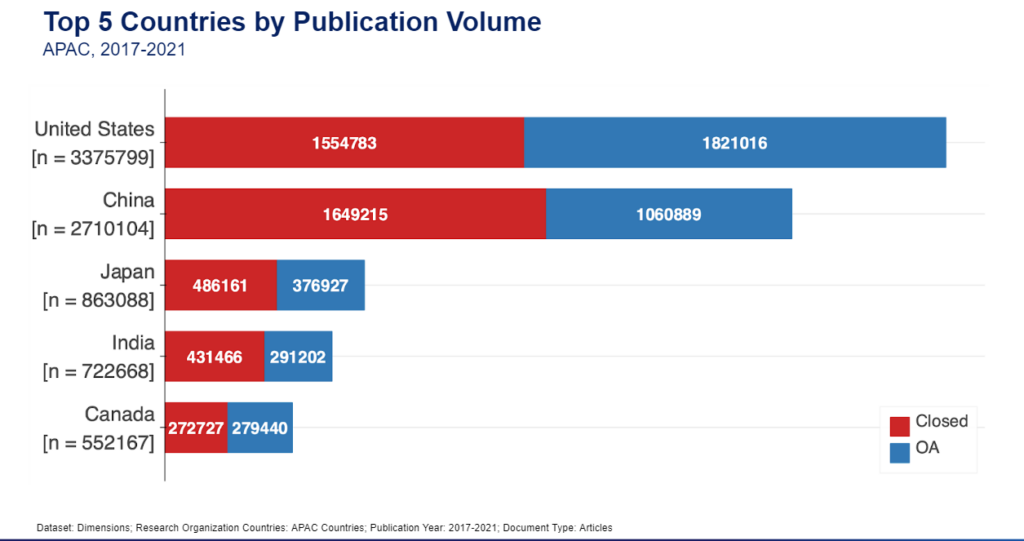
Analysis of publishing trends in research by Professor Michael Khor and Dr. Alana M. Soehartono of Nanyang Technological University (NTU), Singapore, indicates significant growth in open access publishing. In the United States and Canada, there has been significant growth in open access publishing, signifying a shift towards more accessible research, while in Southeast Asia, open access articles have already been the more popular option.

source:www.dimensions.ai

Now, let’s explore the key 4 benefits of open access publishing and how it can positively impact your research career.

1. Increased Visibility and Reach

One of the primary advantages of publishing in open access journals is the increased visibility and reach of your research gains. Your work becomes freely available to researchers, educators, students, and the general public worldwide. This expanded audience can lead to greater recognition of your research and its impact on your field.

2. Quicker Publication Timelines

Traditional publishing can be time-consuming, with lengthy review processes and publication timelines. Open access journals often offer quicker turnaround times, allowing your research findings to reach the academic community and the public more rapidly.

3. Enhanced Impact and Citations

Open access publications are generally more accessible to researchers and the public, increasing the likelihood of citations. This exposure can contribute to your academic and professional reputation, as citations are a vital metric for assessing the impact of research in your field.

4. More Collaboration Opportunities

With open access, researchers can collaborate more easily, as their work is accessible to a wider audience. This can lead to increased opportunities for partnerships, joint projects, and interdisciplinary research, fostering a collaborative academic environment.

Pros and Cons of Open Access Publishing

As you contemplate where to share your valuable research, you may find yourself asking, “Should I publish in an open access journal?” This is a valid question, so let’s compare open access publishing to Lambert Academic Publishing together. This comparison will help you make an informed decision about the best-suited place for your research,

FeatureOpen-Access PublishingLambert Academic Publishing
AccessibilityUnlimited online accessTraditional book distribution channels, including online retailers and libraries
CostTypically involves an article processing chargeAuthors are publishing for free
Design controlAuthors may have greater control of the article design Authors benefit from expert design expertise
SuitabilitySuitable for research articles, conference papers, and other shorter forms of academic workSuitable for comprehensive academic books, theses, and dissertations
VisibilityHigh visibility due to unrestricted access onlineLower visibility due to traditional book distribution channels
Financial Rewards for AuthorsAuthors may have lower opportunities for financial rewards from open-access publications due to publication feesAP offers 12% royalty payments to authors

In conclusion, publishing your research in open access journals offers a multitude of benefits, including increased visibility, quicker publication timelines, enhanced impact, and more collaboration opportunities. 

However, it’s essential to weigh the benefits of open access publishing against potential disadvantages and make an informed decision about the best publishing route for your research. 

At Lambert Academic Publishing, we provide a platform for you to take your research a step further by publishing it as a book. Explore how to publish with us and discover how we can support your research journey.

4 Key Benefits of Open Access Publishing for Your Research Read More »

Unlocking the Benefits of Multilingual Assistance in Academic Publishing

In a world where knowledge knows no boundaries, language barriers have long posed a challenge to academic publishing. According to a 2018 study by the European Commission, over 80% of all scientific papers are published in English, yet this language is the native tongue of only about 5% of the world’s population. This startling fact underscores the urgent need for multilingual assistance in academic publishing as a transformative solution. It’s more than just translation; it’s about building cultural bridges to connect the diverse tapestry of our global audience. In this article, we’ll explore how to tackle this issue head-on, emphasizing the importance of language as a cultural bridge to ensure that knowledge reaches every corner of the globe.

The Multilingual Challenge: A Barrier to Global Knowledge

Academic research is the cornerstone of progress. However, the predominance of English in academic publishing has limited the accessibility of knowledge. Non-native English speakers often face obstacles in accessing and understanding the latest research findings. This linguistic divide threatens to isolate cultures and limit the exchange of ideas.

Multilingual assistance serves as the much-needed bridge that overcomes this linguistic barrier. It’s a comprehensive solution that ensures knowledge remains an inclusive realm:

1 .Cultural Bridging Through Translation

Multilingual assistance begins with translation, but it’s not just about converting words from one language to another. It’s about cultural bridging. Expert translators delve deep into the essence of your research, preserving its significance and meaning in multiple languages.

2. Breaking Down Barriers Through Cultural Adaptation

Cultural adaptation goes beyond translation, seeking to ensure your research remains contextually relevant and meaningful across diverse linguistic backgrounds. It’s about being culturally sensitive, recognizing the nuances that make knowledge accessible to a broader spectrum of readers.

3. Expanding Horizons Through Collaboration

Multilingual publishing doesn’t just extend your readership; it expands your global network. Collaborating with researchers and academics from various linguistic backgrounds enriches your research by bringing together different perspectives. It fosters international collaboration, ensuring academic work is culturally informed.

The Multilingual Revolution

Multilingual publishing democratizes knowledge, transcending the linguistic divide. It allows non-native English speakers to access and engage with research that would otherwise be out of reach. This expansion of accessibility means that knowledge is no longer a privilege reserved for a select few.

Lambert Academic Publishing stands at the forefront of the multilingual assistance in academic publishing. We understand that language is more than a communication tool; it’s a cultural bridge. Our services are designed to help you unlock the full potential of multilingual publishing:

Our team of expert translators specializes in multiple languages, ensuring the precision and cultural relevance of your work. 

Lambert Academic Publishing has established a vast global distribution network, enabling your multilingual publications to reach an extensive international audience.

In the evolving landscape of academic publishing, language should never stand as an obstacle to the exchange of knowledge. Lambert Academic Publishing is committed to tearing down linguistic barriers, embracing cultural diversity, and supporting the globalization of scholarship.

Together, we can unlock the full global potential of scholarly research and transform the way knowledge is shared, transcending the confines of language and culture. See how!

Explore our extensive online library at morebooks.shop, offering a rich collection of books in over 8 languages. 

Unlocking the Benefits of Multilingual Assistance in Academic Publishing Read More »

Do I need the university’s approval to publish my dissertation

Publishing your dissertation can be an exciting and rewarding experience, but it is important to consider the necessary steps before doing so. One question that often arises is whether or not you need the university’s approval to publish your dissertation. The answer to this question depends on a few factors.

Firstly, it is important to understand the difference between publishing your dissertation and making it available through your university’s library. When you submit your dissertation to your university, it is typically archived and made available to the public through the library. This does not necessarily mean that you have published your dissertation, as publishing typically involves a formal process of submitting your work to a publisher and having it reviewed and edited for publication.

If you plan to publish your dissertation through a publisher, you may need to obtain permission from your university. Some universities require students to sign an agreement that gives the university the right to reproduce and distribute their dissertation. This agreement may include restrictions on publishing the work in its original form, or require that certain changes be made to the manuscript before it can be published.

Additionally, if your dissertation includes copyrighted material, such as images or text, you may need to obtain permission from the copyright holders to use that material in your published work. This may require additional permissions and agreements, which can be time-consuming and potentially costly.

It is important to consult with your advisor and the appropriate administrators at your university to determine what, if any, permissions or agreements are necessary before publishing your dissertation. Some universities may have specific policies or procedures in place that outline the requirements for publishing your dissertation, while others may leave it up to the individual student to determine the necessary steps.

In general, it is always a good idea to be transparent and upfront about your intentions to publish your dissertation. This can help to avoid any potential conflicts or misunderstandings down the road, and may even lead to opportunities for collaboration or further research.

In conclusion, whether or not you need the university’s approval to publish your dissertation depends on a few factors, including your university’s policies and any copyrighted material included in your work. It is important to consult with your advisor and appropriate administrators to determine what, if any, permissions or agreements are necessary. Being transparent and upfront about your intentions to publish can help to avoid potential conflicts or misunderstandings, and may lead to opportunities for collaboration or further research.

Can I publish my dissertation regardless of my grades?

Yes, you can still publish your dissertation regardless of your grades. Publishing your dissertation is an opportunity to share your research with the academic community and contribute to the body of knowledge in your field. Your grades are not a determining factor in whether or not your dissertation is worthy of publication.

However, it is important to note that the quality of your research and writing will play a significant role in whether or not your dissertation is accepted for publication. Your dissertation should be well-written, thoroughly researched, and contribute new insights or perspectives to your field of study. If your dissertation is of high quality, it is more likely to be accepted for publication, regardless of your grades.

It is also worth noting that publishing your dissertation can be a competitive process. Depending on your field of study, there may be a high demand for publishing opportunities, and your work may be evaluated alongside many other submissions. In order to increase your chances of acceptance, it is important to carefully review submission guidelines, target journals or publishers that are a good fit for your research, and consider seeking feedback from colleagues or advisors to improve the quality of your manuscript.

In conclusion, while your grades are not a determining factor in whether or not you can publish your dissertation, the quality of your research and writing will play a significant role in the likelihood of acceptance for publication. It is important to carefully review submission guidelines, target appropriate journals or publishers, and seek feedback from colleagues or advisors to increase your chances of success.

Do I need the university’s approval to publish my dissertation Read More »

Exploring the World of Academic Book Publishers: A Comprehensive Guide

Academic book publishing is a significant part of the academic world, as it is through these publications that scholars disseminate their research findings and insights to a wider audience. Whether you are a seasoned academic author or a novice looking to publish your first book, navigating the world of academic book publishers can be a daunting task. In this article, we will explore the world of academic book publishers and provide you with a comprehensive guide to help you make informed decisions about your book publishing journey.

What is an academic book publisher?

Academic book publishers are companies that specialize in publishing books on academic topics such as philosophy, history, social sciences, humanities, and natural sciences. They often have an established reputation in the academic world and provide a platform for scholars to share their research and findings with a broader audience.

Types of academic book publishers

Academic book publishers can be broadly classified into two categories: commercial publishers and university presses. Commercial publishers are profit-driven companies that publish academic books alongside their other publications. They often have larger marketing and distribution networks and can reach a broader audience.
On the other hand, university presses are non-profit entities that are affiliated with universities or academic institutions. They often specialize in publishing books that align with the research interests of their affiliated institutions and have a smaller marketing and distribution network.

Factors to consider when choosing an academic book publisher:

  1. Reputation: Consider the publisher’s reputation in the academic world. A publisher with a good reputation can give your book credibility and increase its visibility.
  2. Target audience: Identify the target audience for your book and choose a publisher that specializes in that field.
  3. Editorial process: Understand the editorial process of the publisher. What is their peer-review process? What is their editing process? How long does it take to publish a book with them?
  4. Marketing and distribution: Consider the publisher’s marketing and distribution network. How will they promote your book? What is their reach, both nationally and internationally?
  5. Copyright and royalties: Understand the copyright and royalty policies of the publisher. Who holds the copyright to the book? What percentage of royalties will you receive?

Some of the top academic book publishers:

  1. Oxford University Press: One of the oldest and most respected university presses, Oxford University Press publishes books across a wide range of academic disciplines.
  2. Cambridge University Press: Another well-respected university press, Cambridge University Press publishes books on subjects such as humanities, social sciences, and science.
  3. Springer: A commercial publisher that specializes in science, technology, and medical books, Springer is one of the largest academic book publishers.
  4. Routledge: Routledge publishes books across a wide range of academic disciplines, including humanities, social sciences, and science.
  5. Palgrave Macmillan: Another well-respected publisher, Palgrave Macmillan specializes in publishing books in the humanities and social sciences.

The core different types of academic publishers

Academic publishers play a crucial role in disseminating knowledge and advancing research in various fields. They serve as gatekeepers of academic work and help to ensure the quality and credibility of research. However, not all academic publishers are the same. In this article, we will explore the different types of academic publishers and their characteristics.

1. University Presses

University Presses are academic publishers that are affiliated with universities. They are typically not-for-profit entities that publish books, journals, and other scholarly works. University Presses are known for their high editorial standards, rigorous peer-review process, and commitment to publishing works that are both intellectually challenging and accessible to a broad audience. They are also committed to publishing works that may not be commercially viable, but are nevertheless important for the advancement of knowledge in a particular field.

2. Commercial Publishers

Commercial Publishers are for-profit entities that publish academic works. They are typically larger than University Presses and have a wider range of subject areas. They may publish books, journals, and other scholarly works, but they are driven by profit rather than academic prestige. Commercial Publishers often have less rigorous editorial standards than University Presses and may prioritize works that are commercially viable over those that are academically rigorous.

3. Open Access Publishers

Open Access Publishers are academic publishers that make their content freely available to the public online. They may operate as not-for-profit or for-profit entities. Open Access Publishers are committed to making research available to as many people as possible, without the financial barriers that can limit access to traditional academic publications. However, there are concerns about the quality of research published by Open Access Publishers, as they may have less rigorous editorial standards than traditional academic publishers.

4. Society Publishers

Society Publishers are academic publishers that are affiliated with professional societies or associations. They may publish books, journals, and other scholarly works in a particular subject area, and they are typically not-for-profit entities. Society Publishers are known for their commitment to advancing knowledge in their field and for their high editorial standards. They may also provide additional benefits to members of the professional society, such as access to exclusive content or discounts on publications.

5. Independent Publishers

Independent Publishers are small academic publishers that are not affiliated with universities or professional societies. They may publish books, journals, and other scholarly works in a particular subject area. Independent Publishers are known for their flexibility and willingness to take risks on works that may not be commercially viable, but are academically rigorous. They may also have a closer relationship with authors than larger publishers, providing more personalized editorial feedback and support.

In conclusion, there are various types of academic publishers, each with their own characteristics and priorities. University Presses prioritize academic rigor and accessibility, while Commercial Publishers prioritize profit. Open Access Publishers prioritize open access and accessibility, but may have lower editorial standards. Society Publishers prioritize advancing knowledge in a particular field, while Independent Publishers prioritize flexibility and personalized support for authors. Understanding the differences between these types of publishers can help authors make informed decisions about where to publish their research.

Exploring the World of Academic Book Publishers: A Comprehensive Guide Read More »

Scroll to Top