

If you’ve recently completed your dissertation and want to share your findings beyond your university, turning it into a book is an excellent next step. A published dissertation allows you to reach a wider academic audience, build your professional reputation, and give lasting visibility to your research.
Many researchers choose to partner with Lambert Academic Publishing to turn their dissertations into professional books with global distribution. The publishing process follows the clear framework outlined in our main resource, How to Publish Your Research Paper as a Book.
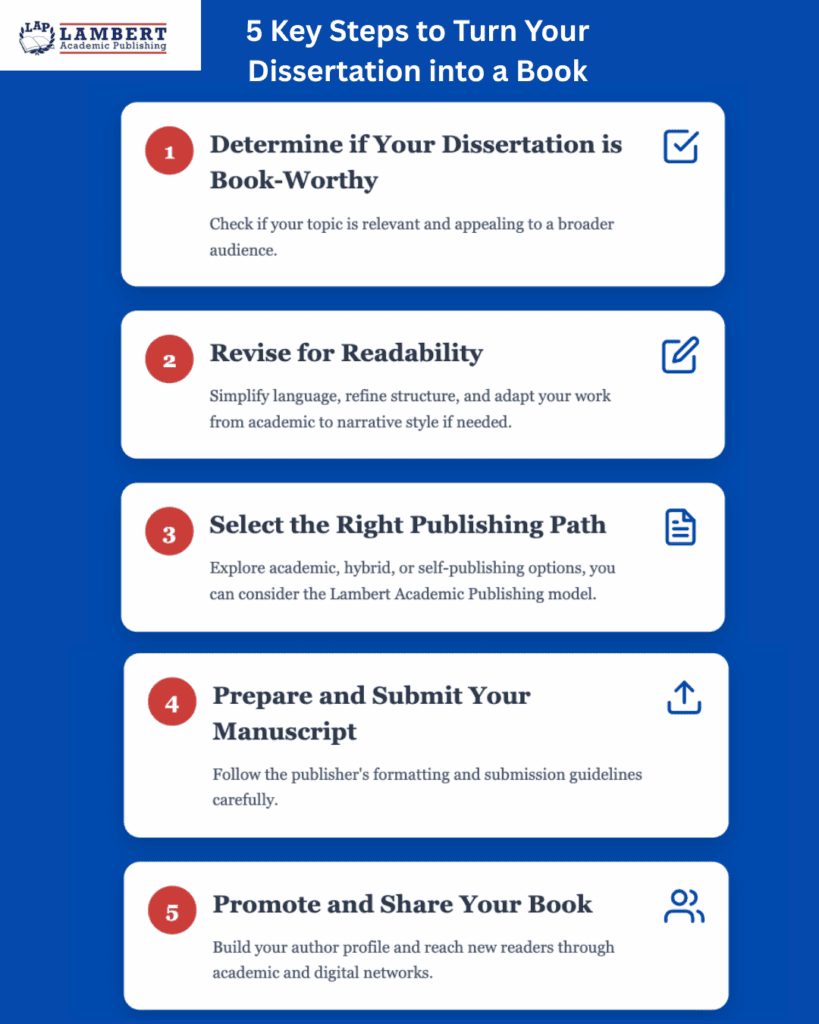
Here are 5 Key Steps to Turn Your Dissertation into a Book:
- Determine if Your Dissertation is Book-Worthy: check if your topic is relevant and appealing to a broader audience.
- Revise for Readability: simplify language, refine structure, and adapt your work from academic to narrative style if needed.
- Select the Right Publishing Path: explore academic, hybrid, or self-publishing options, you can consider the Lambert Academic Publishing model.
- Prepare and Submit Your Manuscript: follow the publisher’s formatting and submission guidelines carefully.
- Promote and Share Your Book: Build your author profile and reach new readers through academic and digital networks.
By following these five steps, you can confidently transform your dissertation into a professionally published book that strengthens your author profile and expands your academic influence.
1. From Dissertation to Book, Evaluate Your Research’s Publishing Potential
Identify market demand and topic relevance
Not all dissertations are suited for publication. Before investing time and effort into the publishing process, do some research to determine if there’s a market for your work. Look for books in your field that are similar to your dissertation and see how well they sell. If there’s demand for your topic, then it’s a good sign that your dissertation could make a successful book.
Compare your research with similar published books
Comparing your research or dissertation with similar books helps you to:
- Identify gaps.
- Validate the book’s relevance.
- Position your book as a unique contribution to your field.
Start by identifying the main variables, concepts, and themes that define your dissertation, then explore how other authors have addressed these ideas. This process not only clarifies your book’s niche but also strengthens your proposal when submitting the manuscript to publishers.
Here are seven key steps that will help you understand how to compare your work with other published books.
- Identify Key Variables and Themes
Analyze your dissertation to pinpoint its central ideas: major topics, theoretical frameworks, or core research questions that define your work. - Search for Comparable Titles
Use academic databases, for example, Lambert Academic library catalogue, or online booksellerslike Google Books or Amazon Academic, to find titles with overlapping subjects or methodologies. - Summarize and Evaluate Similar Works
Review abstracts and synopses of potential comparables to understand the other authors approach, structure, and audience. Take notes of any recurring gaps or limitations that your work addresses. - Establish a Comparative Framework
Set clear criteria for comparison. Here, think more about the research method, theoretical approach, or scope of findings. This helps you make consistent, objective evaluations. - Analyze and Compare
Discuss each shared theme or concept, noting how it appears in your work versus others. Emphasize where your dissertation provides fresh insight, broader data, or a different context. By the way, there is an amazing AI tool, NotebookLM, that helps to gather all the information, files, and make comparison summaries FAST! This tool can do the comparison for you if you have done the research before. - Highlight Your Unique Contribution
Clearly articulate how your research complements existing books. Instead of criticizing other works, focus on how your book adds value by exploring a new perspective, applying a different methodology, or expanding an underexplored subfield. - Use Metrics and Visuals (Optional for Academic Works)
When relevant, include comparative metrics such as citation counts, topic frequency, or statistical data. Simple visuals like charts or tables can make these distinctions clearer to both readers and publishers.
2. Evaluate Whether Your Dissertation Is Ready for Publication
It’s rare that a dissertation can be published as it is. Typically, you’ll need to revise and refine your work to make it more accessible and engaging for a broader audience. Consider hiring a professional editor to help you identify areas that need improvement, or submit your research paper to Lambert Academic, where an editor will be assigned to check your work.
3. Select the Right Publishing Path and publisher
There are several options for publishing your dissertation as a book. You can either self-publish, approach an academic publisher, or try a hybrid publisher, for example, Lambert Academic Publishing. If you’re not sure which route to take, do some research to see which option is the best fit for you and your goals. You can check out the steps on how to publish your book for free and online with Lambert Academic.
4. Prepare and Submit Your Manuscript
Each publisher will have their own submission guidelines, so make sure you read them carefully and follow them to the letter, or you can submit your work online, like it’s with Lambert. Usually, the manuscript submission guidelines require a cover letter alongside the main manuscript, which should include sections such as the abstract, introduction, and references. Figures, tables, and supplementary materials must be provided as separate files (but this can vary for different publishers).
Key elements that should be formatted according to the publisher’s requirements usually include font style, spacing, margins, citation style, and a statement regarding any conflicts of interest.
If you follow the guidelines, there is a higher possibility for your dissertation to be published as a book, and overall, it can be a smoother submission process.
5. Promote and Share Your Book
Once your book is published, it’s up to you to promote it and also the publisher can help you with this. Start building your author platform before your book comes out by creating a website, engaging with your audience on social media, and building relationships with influencers in your field.
Publishing a book can be a lengthy process, so be prepared to wait for your book to hit the shelves. But remember, the wait will be worth it when you see your dissertation transformed into a tangible book that can be shared with the world.
Publishing your dissertation as a book is a rewarding way to share your research with a wider audience and make an extra buck. By following these tips, you’ll be well on your way to turning your dissertation into a published work that you can be proud of.
Why Turn Your Dissertation Into a Book?
Turning your dissertation into a book can strengthen your academic career, expand your reach, and build your professional reputation. It’s more than just rewriting; it’s transforming years of specialized work into a lasting, influential publication. Publishing a book fulfills major academic milestones like tenure and promotion, boosts your job prospects, and positions you as a credible, published author in your field.
A book shares your findings with a far wider audience than a dissertation ever could. It helps you focus on your main ideas and present your research in a clearer, more engaging way.
Moving from dissertation to book establishes you as an expert and thought leader. Your work gains visibility, longevity, and the potential to influence both your discipline and public understanding.
Get paid when your research is sold, aka ROYALTY PAYMENTS
When you publish your research with Lambert Academic Publishing (LAP), you can earn royalty payments every time your book is sold. Royalties are a share of the book’s revenue, typically a set percentage of each sale as agreed in your publishing contract. This means your research doesn’t just reach a wider audience; it can also generate passive income over time.
Unlike traditional academic journals, which rarely pay authors, LAP ensures that researchers benefit directly from their intellectual work. Every copy sold through our global distribution network, whether online or in print, contributes to your royalty balance.
Publishing your dissertation as a book is more than the final step in your academic journey — it’s the beginning of your voice as an author. By sharing your research, you extend its impact, inspire new ideas, and contribute to the global academic conversation. With Lambert Academic Publishing, you can publish confidently, earn royalties, and see your work reach readers worldwide.
Start your publishing journey today with LAP and turn your dissertation into a book that makes a lasting difference.