
If you’ve recently completed your dissertation and want to share your findings beyond your university, turning it into a book is an excellent next step. A published dissertation can reach a wider academic audience, build your professional reputation, and give lasting visibility to your research. Many researchers partner with Lambert Academic Publishing through the framework in How to Publish Your Research Paper as a Book.
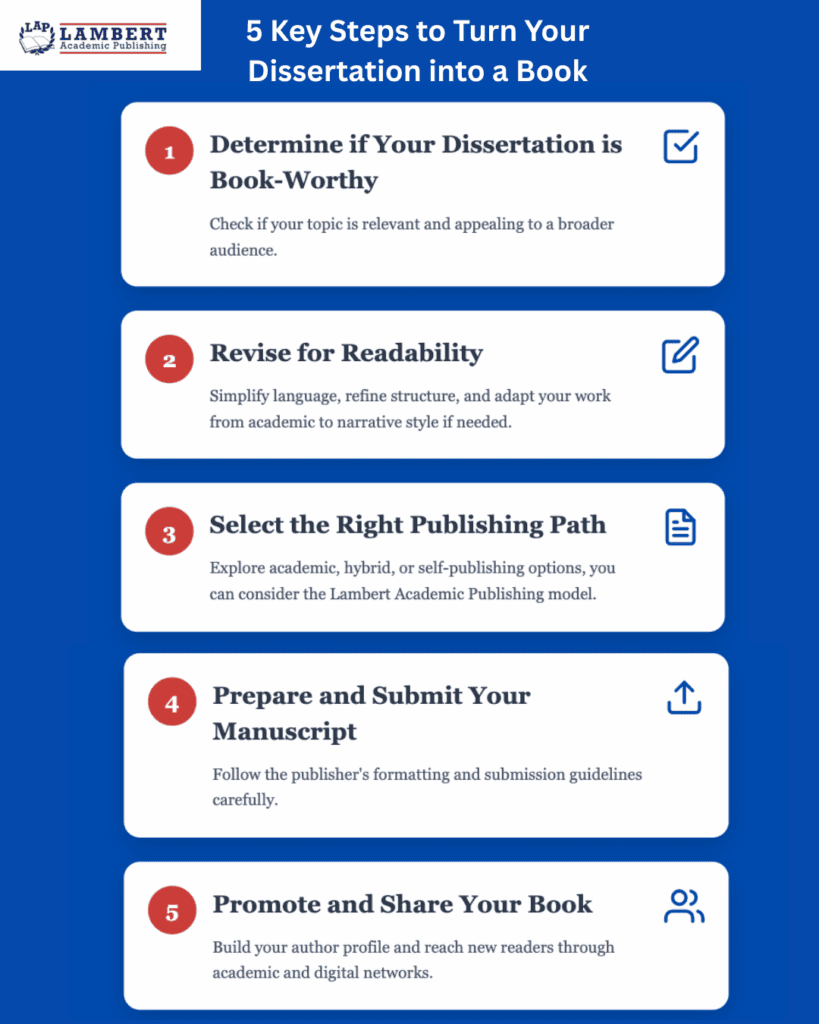
Here are five key steps:
- Determine if your dissertation is book-worthy: Check whether your topic is relevant and appealing to a broader audience.
- Revise for readability: Simplify language, refine structure, and adapt academic work to a more narrative style where needed.
- Select the right publishing path: Explore academic, hybrid, or self-publishing options.
- Prepare and submit your manuscript: Follow formatting and submission guidelines carefully.
- Promote and share your book: Build an author profile and reach readers through academic and digital networks.
1. From Dissertation to Book: Evaluate Your Research’s Publishing Potential
Identify market demand and topic relevance
Not every dissertation is suited for publication. Before investing time and effort, determine whether there is a market for your work. Look for comparable books in your field and assess demand for the topic.
Compare your research with similar published books
Comparing your work with similar books helps identify gaps, validate relevance, and position your book as a unique contribution. Identify the variables, concepts, and themes that define your dissertation, then explore how other authors have addressed them.
- Identify key variables and themes. Analyze central topics, theoretical frameworks, and core research questions.
- Search for comparable titles. Use academic databases, the Lambert Academic library catalogue, or booksellers such as Google Books and Amazon Academic.
- Summarize and evaluate similar works. Review abstracts and synopses, noting recurring gaps or limitations your work addresses.
- Establish a comparative framework. Set criteria such as research method, theoretical approach, or scope of findings.
- Analyze and compare. Discuss shared themes and emphasize fresh insight, broader data, or a different context.
- Highlight your unique contribution. Focus on how your book adds value through a new perspective, methodology, or underexplored subfield.
- Use metrics and visuals where relevant. Citation counts, topic frequency, statistics, charts, and tables can clarify distinctions.
2. Evaluate Whether Your Dissertation Is Ready for Publication
It is rare that a dissertation can be published unchanged. Usually it needs revision and refinement to become accessible and engaging for a broader audience. A professional editor can help identify areas to improve, or you can submit research to Lambert Academic Publishing for editorial review.
3. Select the Right Publishing Path and Publisher
You can self-publish, approach an academic publisher, or use a hybrid publisher. Research the route that best fits your goals and review how to publish your book for free and online with Lambert Academic Publishing.
4. Prepare and Submit Your Manuscript
Read each publisher’s submission guidelines carefully. They commonly require a cover letter alongside the manuscript, including an abstract, introduction, and references. Figures, tables, and supplementary materials may need separate files. Font style, spacing, margins, citation style, and conflict-of-interest statements should all meet publisher requirements.
Following the guidelines improves the chance of publication and makes submission smoother.
5. Promote and Share Your Book
Once published, promote your book with support from the publisher. Build your author platform before release by creating a website, engaging on social media, and building relationships with people in your field. Publishing can be lengthy, but it can be rewarding when your dissertation becomes a tangible work for readers.
Turning a dissertation into a book can strengthen an academic career, expand your reach, and build professional reputation. It transforms years of specialized work into a lasting publication, can support milestones such as tenure and promotion, and positions you as a credible published author.
Get paid when your research is sold: royalty payments
When you publish with Lambert Academic Publishing, you can earn royalty payments when your book sells. Royalties are a share of book revenue, typically a percentage of each sale agreed in the publishing contract. Global distribution in print and online can contribute to a royalty balance.
Publishing a dissertation as a book is more than a final academic step: it begins your voice as an author. By sharing research, you extend its impact, inspire new ideas, and contribute to global academic conversation.