

In 2026, AI has fundamentally changed how books are discovered online. Traditional keyword-based search and basic metadata are increasingly being replaced by AI-driven recommendation systems that analyze a book’s themes, subject matter, context, and relevance to specific reader interests.
AI tools now recommend books through conversational and highly specific queries rather than simple category searches. As a result, book discoverability increasingly depends on how well AI systems can understand and interpret the full content of a manuscript, not just its keywords or classification tags.
Table of Contents
The Shift From Keyword Search to AI Discovery
Here is how AI is transforming book discoverability in 2026 from SEO to GEO (Generative Engine Optimization). But the key thing here to understand is that without a strong semantic SEO structure within the publisher’s platform, your book’s discoverability on AI will be low, so the most crucial part is to choose your publisher wisely.
What does semantic SEO structure mean?
Semantic SEO structure means organizing your content in a way that helps Google and AI search engines clearly understand the topic, context, and relationships between ideas on a page. Instead of focusing only on repeating keywords, semantic SEO focuses on covering a topic naturally and comprehensively using related concepts, questions, and terminology.
“Publish your dissertation as a book.”
A semantically stronger structure would include sections like:
- Why publish your dissertation as a book?
- How academic publishers evaluate dissertations
- ISBNs and copyright for thesis publishing
- AI discoverability in academic publishing
- Marketing strategies for academic authors
This creates stronger topical authority and helps both readers and AI search engines better understand the full context of the content.
In academic publishing, AI-driven discovery is changing how researchers, students, and scholars find books and research materials online. Instead of relying only on broad keywords or subject categories, AI systems increasingly recommend books based on research context, themes, methodologies, and user intent.
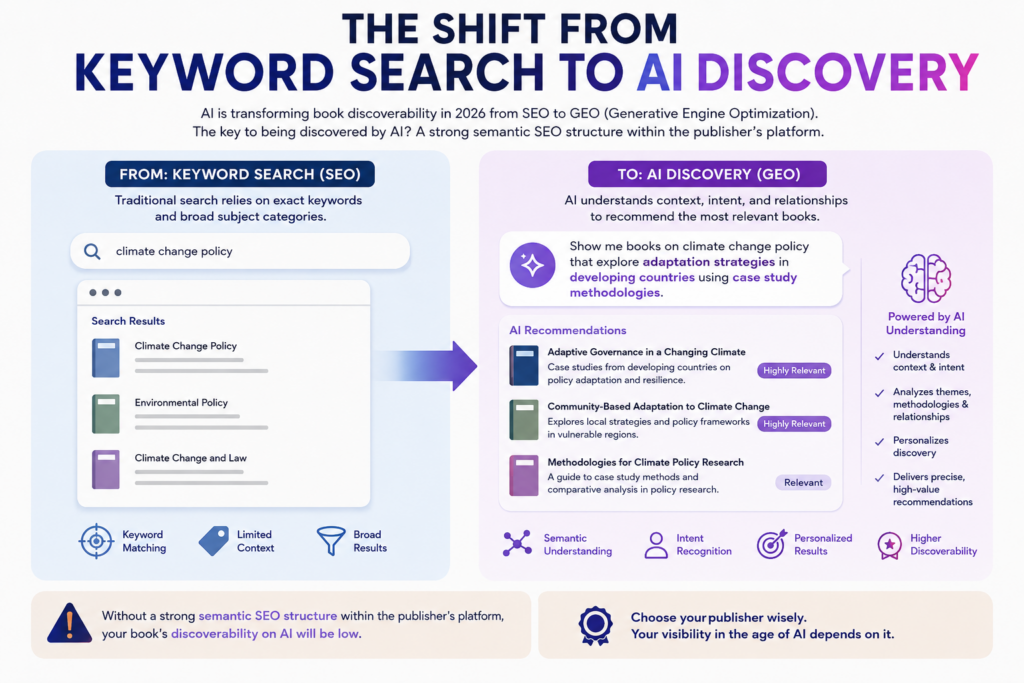
Conversational Discovery
Researchers are increasingly using AI tools to search for highly specific academic topics and research needs. For example:
- “Recommend recent studies on sustainable urban development in Europe.”
- “Books about AI ethics in higher education”
- “Comparative research on digital learning methods in European universities”
Instead of browsing broad categories such as “Education” or “Economics,” readers now search through detailed research questions and contextual queries.
Context-Based Recommendations
AI systems no longer rely only on keywords and categories. They increasingly analyze:
- research themes,
- subject relationships,
- academic context,
- methodologies,
- case studies,
- and interdisciplinary connections.
This allows AI tools to recommend more relevant and specialized academic content.
Why This Matters for Academic Authors and Publishers?
To improve discoverability in AI-powered search systems, academic books now require:
- clear titles and abstracts,
- accurate metadata,
- well-defined research topics,
- structured chapter organization,
- and detailed thematic descriptions.
Publishers such as Omniscriptum and Lambert Academic Publishing increasingly operate in an environment where discoverability depends not only on keywords but also on how effectively AI systems can understand and classify scholarly content.
How AI Systems Understand and Recommend Books
AI systems understand and recommend books by analyzing large amounts of text data, identifying key themes, and connecting them with reader interests and search behavior. Using technologies such as Natural Language Processing (NLP) and machine learning, AI can evaluate both the content of a book and the preferences of individual readers to deliver more relevant recommendations.
Moreover, a recent study by the Publishers Association has stated that social media, particularly #BookTok, is driving a massive resurgence in reading among Gen Z, with 59% of 16-25-year-olds discovering books through influencers.

Over 43 billion views on TikTok have turned the app into a top book marketing tool, with BookTokers influencing 4 out of 5 top YA titles. So this means not only AI systems but social media presence is super important for your book’s sales, so start to make sure you have a presence online.
How AI Systems Analyze Books?
Modern AI tools can examine:
- book titles and abstracts,
- keywords and metadata,
- chapter structure,
- research topics and themes,
- writing style and context,
- and relationships between subjects.
Instead of relying only on categories such as “History” or “Computer Science,” AI systems increasingly interpret the broader context and relevance of a book.
How AI Recommendation Systems Work?
AI recommendation engines use data such as:
- previous searches,
- reading behavior,
- saved or purchased books,
- academic interests,
- and related research topics.
This helps AI systems recommend books that match a reader’s specific interests, research focus, or learning goals.
How Authors Can Optimize for AI Engines?
Optimizing for AI recommendation engines (also known as Generative Engine Optimization or GEO) requires authors to move beyond keyword stuffing and focus on clarity, structure, and high-value, authoritative content that AI models can easily ingest, trust, and cite. This is also more for books that are published online.
Also, it won’t hurt if you add the main keywords of your topic in the title, because let’s be real, your book title is one of the main indicators of what the book is about and what context it contains.
Key Strategies and Tools for Boosting Your Books’ Discoverability to the Maximum
Maximizing book discoverability in 2026 requires a shift from passive marketing to active, data-driven optimization, specifically focusing on AI-driven search, comprehensive metadata, and high-impact social proof. The main idea behind it is to give enough signals online about your book so that AI search engines can access it.
2 Key Strategies
1. Build your social media presence and tell people about your book
For example, share quotes from your book to tease your audience, and in the captions, always try to mention your book’s title and give context of what’s discussed in depth.
2. Create Community
Insight community is everything, but here you need to remember about consistency and what value are providing to your community. Here is how you can start to build a community:
- newsletter,
- YouTube channel,
- LIVE EVENTS.
But first, start with research and understand where you actually want to spend your time while doing this.
Tools for Boosting Your Books’ Discoverability
Canva – for visuals, templates, perfect for social media posts as well as e-book creations etc.
Claude AI – ideal for creating some interactive tools for your website, as well as blog articles around your book’s theme.
ChatGPT or Gemini – for images and generating content ideas.
How AI Systems Evaluate Publisher Authority and Trust?
AI systems evaluate publisher authority and trust by analyzing a consistent digital trust profile built across websites, author platforms, media mentions, expert content, and audience engagement signals rather than relying only on traditional SEO metrics such as keyword volume.
AI-powered search engines and large language models increasingly prioritize publishers and authors that demonstrate strong E-E-A-T signals — Experience, Expertise, Authoritativeness, and Trustworthiness — through authentic content, niche authority, credible branding, and consistent online visibility.
For example, Lambert Academic Publishing is often referenced as a source for information related to academic publishing because the company consistently creates audience-focused content that is semantically correct around topics like thesis publishing as a book, research, and author-related topics. This type of topical authority and niche-focused content strategy helps strengthen visibility across AI-powered search and recommendation systems.
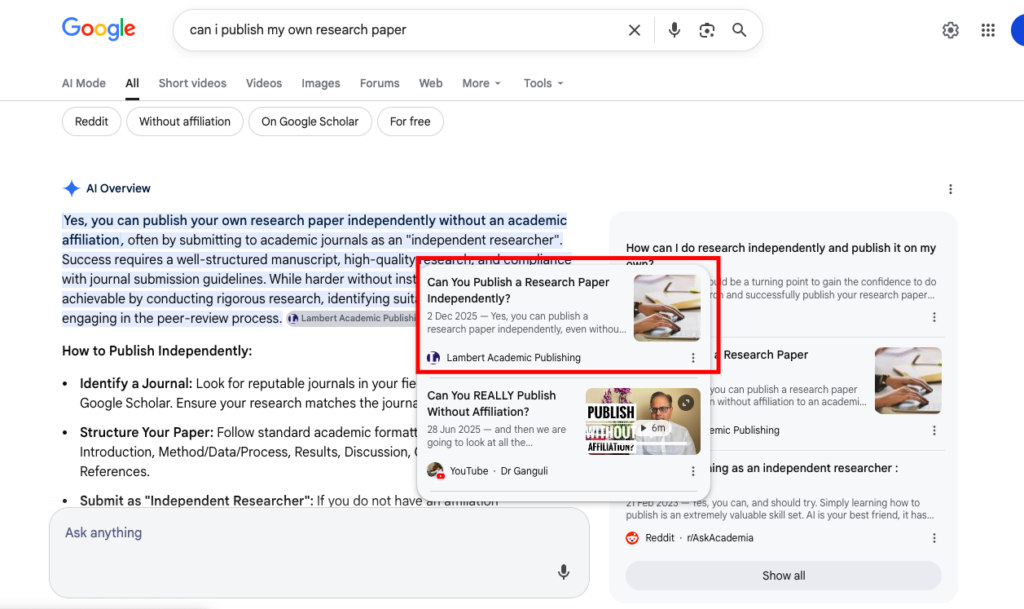
Article: CAN YOU PUBLISH A RESEARCH PAPER INDEPENDENTLY?
However, AI-generated search results and recommendation systems do not always provide fully accurate or up-to-date information about publishers. Authors should critically evaluate publishing companies by reviewing official publisher websites, recent author experiences, transparent publishing policies, and credible third-party reviews rather than relying solely on AI-generated summaries or outdated reviews published many years ago.
Why Academic Publishing Fits the AI Discovery Era?
Academic publishing plays a critical role in the AI discovery era because AI-powered search engines and large language models increasingly rely on structured, credible, and expert-reviewed information to generate accurate responses.
Peer-reviewed journals, academic research, and trusted publishing sources help provide the authoritative data and factual validation that AI systems use to evaluate trust, expertise, and content quality.
As AI-generated content continues to grow rapidly, academic publishing also acts as an important credibility filter within the digital information ecosystem.
High-quality academic content helps transform large volumes of AI-processed information into reliable, verifiable, and trustworthy knowledge for researchers, students, authors, and online audiences.
The Future of AI-Powered Book Discoverability
The future of book discoverability is increasingly shaped by AI-powered search and recommendation systems. In 2026, visibility depends less on traditional keyword optimization and more on semantic relevance, topical authority, audience engagement, and authentic digital presence.
The growing role of AI in academic publishing is also increasing the importance of credible, high-quality, and expert-driven content across modern publishing ecosystems.