
Publishing a PhD thesis as a book involves transforming doctoral research into an academic book that presents a complete argument, explains its significance, and communicates its contribution to a wider scholarly audience beyond examiners. While a thesis is built around a question, a book starts with clear answers and focuses on why they matter, placing the research in a wider academic context and showing its relevance and impact.
Research carried out as part of a PhD represents years of focused work and original thinking. While a thesis is written primarily for examiners, its value often goes far beyond the doctoral process. Many successful academic books are based on PhD research and are published with Lambert Academic Publishing.
Turning a PhD thesis into a book allows you to present your ideas in a more accessible way and take part in academic conversations beyond the examination stage.
Is Your PhD Thesis Ready to be Turned into a Book?
To understand whether your PhD thesis can be published as a book, answer these questions:
- Does your thesis address a topic that is of interest to a wider audience?
- Can you present your research in a way that is accessible to non-specialists?
- Are there existing books on your topic, and if so, what makes your research unique?
If your thesis has potential, identify publishers that specialize in your subject area and have a strong track record of publishing academic work. Their guidelines will indicate what they are looking for in a book proposal.
What Are Your Options if You Decide to Publish?
Two main options when publishing PhD research
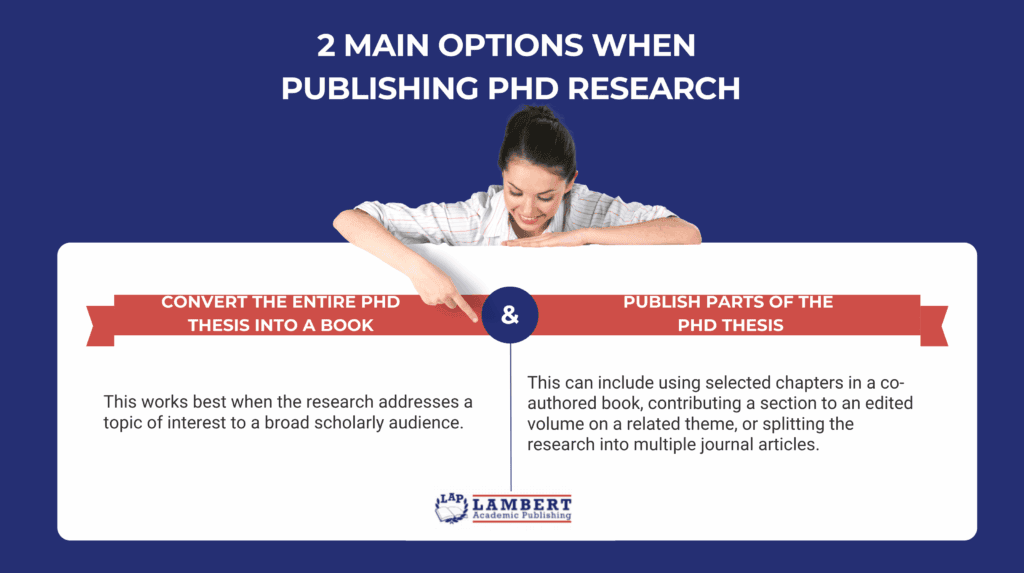
Most PhD research is first shared through journal articles, while some projects are developed into full academic books. You can convert the entire thesis into a book when the research interests a broad scholarly audience, or publish parts of the thesis through selected chapters, an edited volume, or multiple journal articles. The latter approaches can reach specific audiences, although they may reduce the sense of a unified narrative.
What Publishers Consider Before Publishing a PhD Thesis as a Book
An academic publisher connects research with the readers who need it. Each publisher serves different audiences, follows different models, and applies different evaluation criteria. Most focus on three questions:
- Scope: Is the research broad enough to interest a wider scholarly audience beyond a narrow specialization?
- Quality: Does the work meet academic standards for originality, methodology, and contribution to the field?
- Development potential: Can editorial feedback or peer review strengthen the manuscript and address gaps?
Discoverability also matters. Publishers such as Lambert Academic Publishing focus on global distribution, clear metadata, and formats that help research reach readers beyond traditional academic channels.
The Book Proposal and Publisher Guidelines
Review publisher guidelines early to understand whether your PhD research fits and how to frame it as a book rather than a thesis. A strong proposal presents research in an engaging, accessible way, often by revising parts of the thesis, reducing highly technical sections, and explaining why the research matters beyond examination. Feedback from supervisors, colleagues, and mentors can be valuable.
Publishers may involve internal editors or external reviewers. If accepted, you typically work with an editor to revise and refine the manuscript into a coherent academic book.
Your manuscript
Preparing a PhD thesis for book publication shifts focus from examiners to readers. Publishers typically expect a condensed or rewritten literature review and methodology, a restructured narrative with a clear central argument, less repetition, and consistent focus on the intended audience.
Publishing a PhD thesis as a book transforms examiner-focused research into a reader-focused academic contribution. When scope, structure, and audience align with publisher expectations, doctoral research can continue to inform, inspire, and contribute to academic discussion well beyond the doctoral stage.